
When a business finds itself in a declining market, failing to stay in lock step with customer demand poses an existential threat. Trends and other market forces that impact commercial opportunities need to appear on the planning radar. Therefore, traditional push-driven supply chains are wholly unfit for this situation.
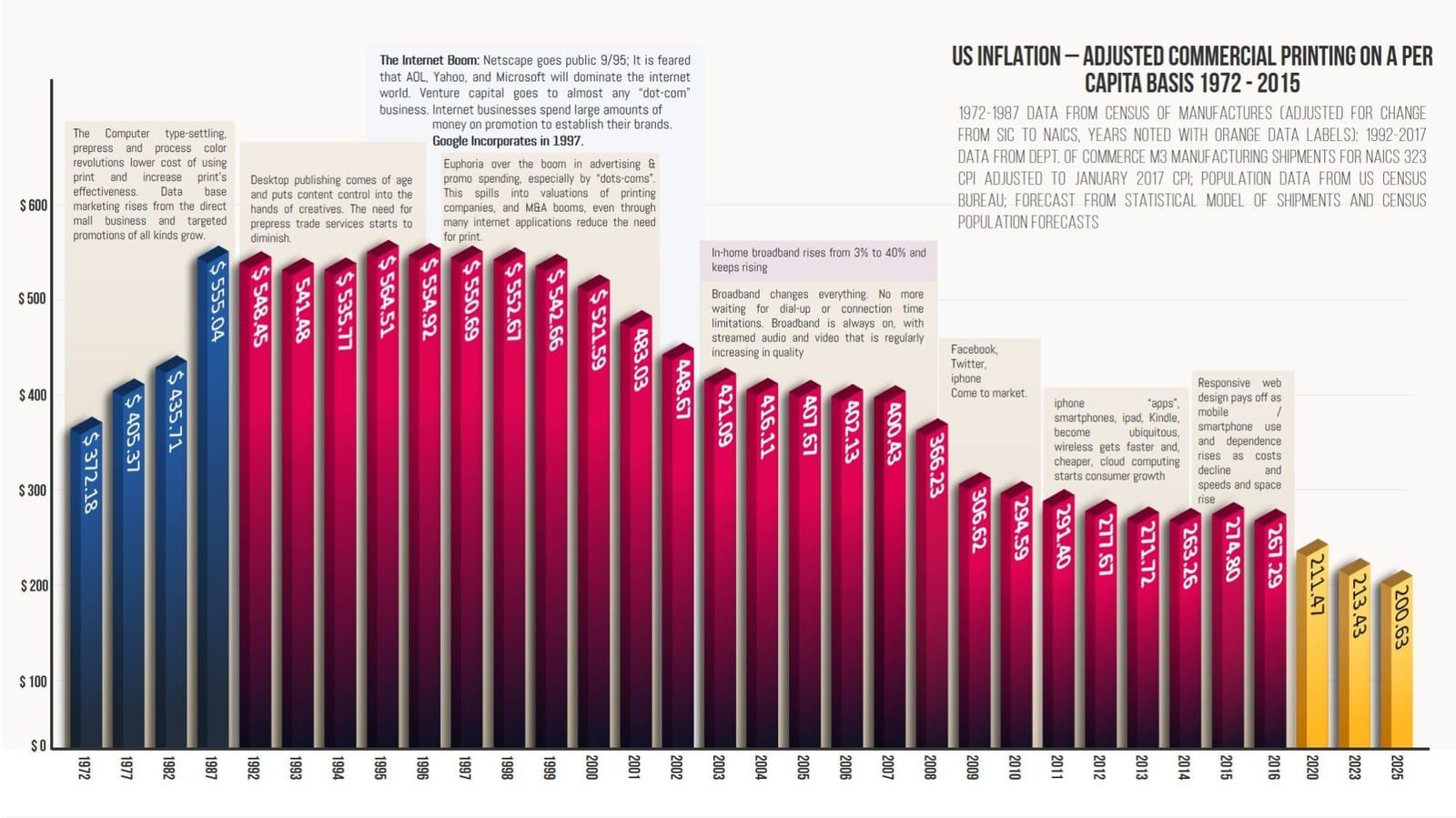
Fine paper is an example of an industry whose total addressable market has been shrinking for decades and looks set to continue (see figure). This once high-volume and personal business has been turned right on its head.
 Rather than cutting back, our customer Mohawk Industries decided to lean in. It bought its main rivals to become North America’s largest fine paper manufacturer.[1] Mohawk sought to profit from the resurgent demand for “analog experiences” by owning the fine paper space and transforming its extended supply chain.
Mohawk’s SVP of supply chain John Angleson described the scale of the challenge: “The relationship between the manufacturer and distributor in the paper business has typically been characterized by various forms of manipulation, both positive and negative. We had to move all the players out of their comfort zones, into a data-driven, collaborative culture.”
In the first phase Mohawk overhauled its own internal operations, implementing a centralized Sales and Operations Planning (S&OP) process to manage its business in a more demand-driven way. The company elected to hold weekly (rather than the more typical monthly) COO-led executive reviews to monitor demand trends and progress against the plan. These sessions resulted in improved make-to-stock and make-to-order service levels. They also cut inventory levels, grew sales and resolved capacity issues.
Their S&OP program, however, was only the beginning. The second phase involved Mohawk extending their new supply chain improvements out to its distribution network.
To overcome historical obstacles, Angleson set three ambitious goals:
Rather than cutting back, our customer Mohawk Industries decided to lean in. It bought its main rivals to become North America’s largest fine paper manufacturer.[1] Mohawk sought to profit from the resurgent demand for “analog experiences” by owning the fine paper space and transforming its extended supply chain.
Mohawk’s SVP of supply chain John Angleson described the scale of the challenge: “The relationship between the manufacturer and distributor in the paper business has typically been characterized by various forms of manipulation, both positive and negative. We had to move all the players out of their comfort zones, into a data-driven, collaborative culture.”
In the first phase Mohawk overhauled its own internal operations, implementing a centralized Sales and Operations Planning (S&OP) process to manage its business in a more demand-driven way. The company elected to hold weekly (rather than the more typical monthly) COO-led executive reviews to monitor demand trends and progress against the plan. These sessions resulted in improved make-to-stock and make-to-order service levels. They also cut inventory levels, grew sales and resolved capacity issues.
Their S&OP program, however, was only the beginning. The second phase involved Mohawk extending their new supply chain improvements out to its distribution network.
To overcome historical obstacles, Angleson set three ambitious goals:
Rather than cutting back, our customer Mohawk Industries decided to lean in. It bought its main rivals to become North America’s largest fine paper manufacturer.[1] Mohawk sought to profit from the resurgent demand for “analog experiences” by owning the fine paper space and transforming its extended supply chain.
Mohawk’s SVP of supply chain John Angleson described the scale of the challenge: “The relationship between the manufacturer and distributor in the paper business has typically been characterized by various forms of manipulation, both positive and negative. We had to move all the players out of their comfort zones, into a data-driven, collaborative culture.”
In the first phase Mohawk overhauled its own internal operations, implementing a centralized Sales and Operations Planning (S&OP) process to manage its business in a more demand-driven way. The company elected to hold weekly (rather than the more typical monthly) COO-led executive reviews to monitor demand trends and progress against the plan. These sessions resulted in improved make-to-stock and make-to-order service levels. They also cut inventory levels, grew sales and resolved capacity issues.
Their S&OP program, however, was only the beginning. The second phase involved Mohawk extending their new supply chain improvements out to its distribution network.
To overcome historical obstacles, Angleson set three ambitious goals:
- Change the relationship between the manufacturer and distributor from manipulation to collaboration
- Change the definition of success from how much paper the distributor buys to how much its sells
- Establish joint responsibility for inventory to reduce the risk of obsolescence