Demand Planning Software & AI Forecasting Solutions
Improve forecast accuracy, reduce inventory, and align supply chain decisions with AI-driven demand planning.
ToolsGroup demand planning software combines probabilistic forecasting, AI forecast augmentation, and real-time demand sensing to help organizations improve forecast accuracy, reduce inventory costs, increase service levels, and respond faster to market demand across complex global supply chains.
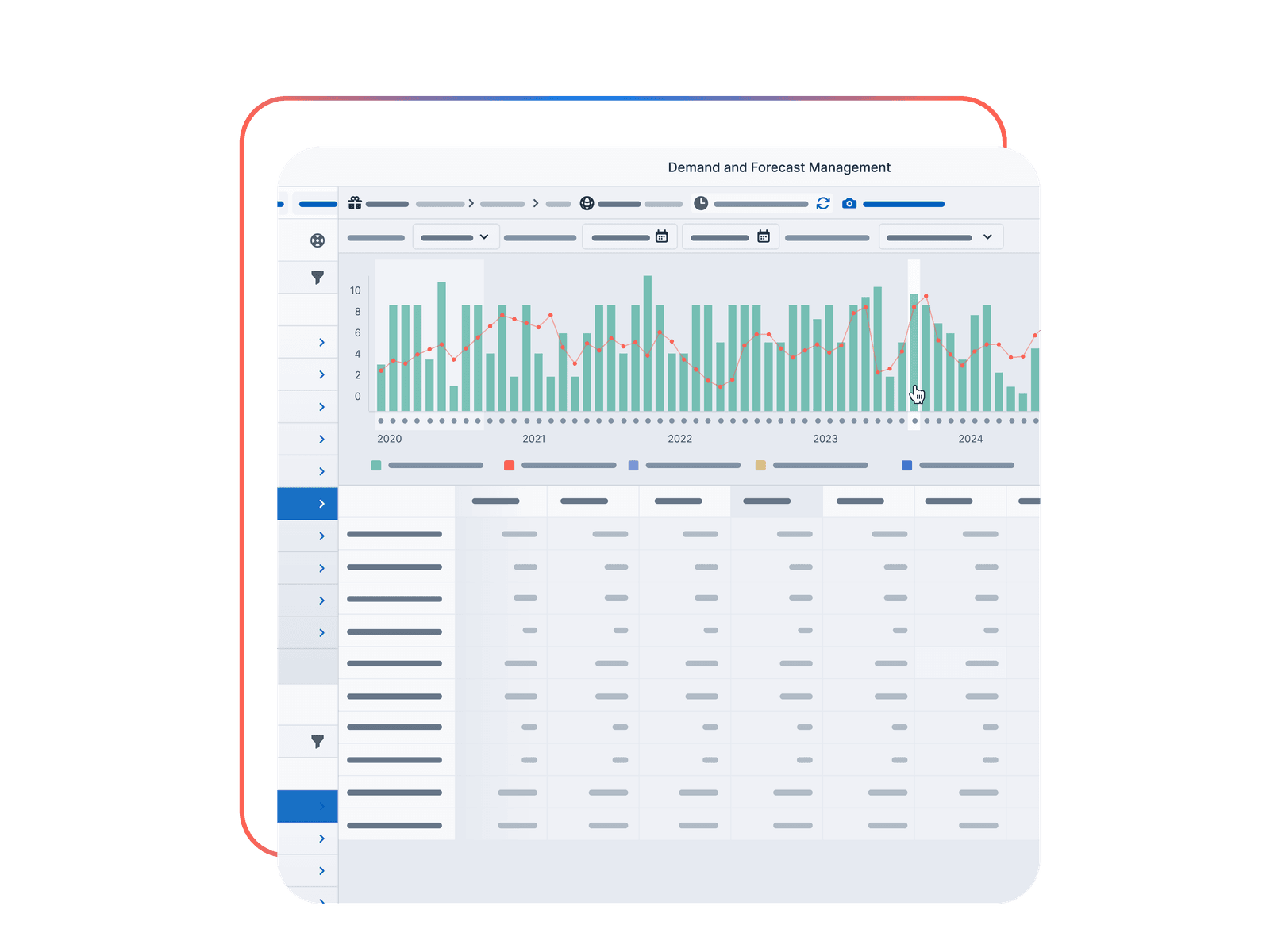
Improve Forecast Accuracy and Reduce Inventory Risk
AI-driven demand planning helps organizations improve forecast reliability, reduce inventory costs, increase responsiveness, and maintain high customer service levels.
-
5-15 pt
Forecast accuracy improvement with AI forecasting
-
40-50 %
Better forecastability of long-tail SKUs
-
40-90 %
Demand Planning workload reduction through automation
-
10-15 %
Fewer Lost Sales
Overview
AI-Powered Demand Planning Built for Supply Chain Complexity
ToolsGroup demand planning software helps organizations improve forecast accuracy by combining probabilistic forecasting, machine learning, and real-time demand sensing into one connected planning environment. Instead of relying on static point forecasts, the platform models uncertainty directly to optimize inventory, service levels, and supply decisions under changing market conditions. Teams can automate repetitive planning activities, align demand and supply decisions, and focus on high-impact exceptions rather than manual spreadsheet analysis. Designed for manufacturers, aftermarket organizations, wholesale distributors, and retailers, the platform helps organizations reduce inventory costs, improve service levels, and respond faster to demand volatility while scaling planning operations across large global networks.
Key Benefits
Reduce Inventory Levels
Respond to Demand Volatility
Automate Planning Decisions
How ToolsGroup Is Different
-
Probabilistic modeling
Probabilistic modeling delivers higher forecast accuracy across intermittent, seasonal, long-tail, lumpy, and promotion-driven demand.
-
Self-adaptive AI forecasting
Self-adaptive AI forecasting continuously improves forecast accuracy throughout the product lifecycle while reducing bullwhip effects.
-
Inventory-aware demand shaping
Inventory-aware demand shaping gives businesses the ability to forecast demand and actively influence it using commercial levers.
Traditional Forecasting Creates Supply Chain Risk
- Static point forecasts fail to capture demand variability, increasing inventory risk and reducing responsiveness to market changes.
- Spreadsheet-driven planning processes create slow, disconnected workflows across demand, supply, and operations teams.
- Demand volatility, promotions, seasonality, and external disruptions make accurate forecasting increasingly difficult.
- Poor forecast accuracy leads to excess inventory, stockouts, lost sales, and declining customer service performance.
AI-Driven Demand Planning
- Probabilistic forecasting models uncertainty directly, improving inventory decisions and service-level performance.
- AI continuously analyzes demand signals, seasonality, promotions, and operational changes in real time.
- Automated planning workflows reduce manual effort while improving speed and decision-making consistency.
- Connected planning aligns demand, supply, inventory, and operational decisions across the organization.
Connected Capabilities Across Demand Planning Operations
Integrated solutions that improve forecasting accuracy, responsiveness, and planning efficiency across the supply chain.
-
Probabilistic Forecasting
Model uncertainty directly using AI-driven forecasting that improves inventory and service-level decisions.
Explore Forecasting : Probabilistic Forecasting -
Collaborative Demand Planning
Align sales, operations, and supply teams around one consensus forecast and planning workflow.
Explore Collaboration : Collaborative Demand Planning -
Demand Sensing
Detect changing demand patterns in real time using AI-driven sensing and adaptive planning.
Explore Sensing : Demand Sensing -
Demand Shaping
Control demand using pricing, promotions, and inventory-aware planning decisions.
Explore Shaping : Demand Shaping
Trusted by Leading Global Supply Chain Teams


-
With ToolsGroup, we have the AI-driven supply chain planning solutions that allow us to adapt quickly and stay flexible, helping us meet our own business goals while delivering on our promises to customers and strengthening our relationships with suppliers

-
We can now run interim monthly reports between the quarterly reports that provide very rich, useful data by region. Each person now leaves these meetings with a much clearer picture of what needs to be accomplished.
 Impact 50% Reporting sped up
 -
Absolutely key to our success has been transforming to a data-driven culture, working on a single view of the truth and actively, continuously managing our data.
 Impact 93% Service Levels
Why Enterprises Choose AI-Driven Demand Planning
ToolsGroup helps organizations move beyond static forecasting with probabilistic AI, real-time demand sensing, and connected planning workflows.
Feature
ToolsGroup
Traditional Planning
Forecasting Approach
ToolsGroup Probabilistic forecasting models uncertainty and demand variability continuously
Traditional Planning Deterministic forecasts rely on single-number predictions and averages
Decision Making
ToolsGroup AI-powered recommendations prioritize actions that improve business outcomes
Traditional Planning Planners manually analyze reports and make reactive decisions
Demand Visibility
ToolsGroup Continuous demand sensing improves responsiveness to changing market conditions
Traditional Planning Demand changes are identified after periodic forecast updates
Planning Alignment
ToolsGroup Connected planning synchronizes demand, inventory, supply, and operations
Traditional Planning Functional teams operate independently with disconnected planning processes
Built for Modern Global Supply Chain Teams
ToolsGroup demand planning software supports retailers, manufacturers, distributors, and planning leaders managing volatility, forecasting complexity, and large-scale supply chain operations.
Demand Planning Teams
Improve forecast accuracy, reduce manual forecasting effort, and respond faster to changing demand patterns using probabilistic AI forecasting and connected planning workflows.
Supply Chain Leaders
Reduce inventory costs, improve service levels, and align demand, supply, and operational planning decisions across complex global supply chain networks.
Retail & Inventory Teams
Improve inventory positioning, reduce stockouts, and optimize replenishment decisions using adaptive forecasting and real-time demand sensing capabilities.
Demand Planning Insights
Guides, research and customer results from teams solving the same problem.
-

Improving Production Planning Accuracy in Industrial Manufacturing
A practical guide to improving production planning accuracy across demand, inventory, capacity, scenarios, and execution feedback.
Read more -

Demand Sensing: Turning Short-Term Signals Into Better Decisions
Demand sensing brings near-term signals into daily planning to improve replenishment, allocation, and exception management.
Read more -

Forecast Accuracy in Decision-Centric Supply Chain Planning
Forecast accuracy alone rarely moves supply chain outcomes. Shifting the focus to decision quality is what improves service, inventory, and cost.
Read more
Frequently Asked Questions
Everything you need to know about demand planning with ToolsGroup
What is demand planning in supply chain management?
Demand planning is the process of forecasting future customer demand to help organizations optimize inventory, supply, production, and operational decisions. Effective demand planning improves forecast accuracy, reduces excess inventory, minimizes stockouts, and helps organizations maintain high service levels across complex supply chains.
How does demand planning differ from demand forecasting?
Demand forecasting focuses specifically on predicting future customer demand, while demand planning uses those forecasts to drive broader supply chain decisions such as inventory optimization, replenishment, production planning, and operational alignment across departments.
How does AI improve demand planning accuracy?
AI improves demand planning accuracy by analyzing large volumes of historical, operational, and real-time demand data continuously. Machine learning models can identify patterns, seasonality, volatility, and changing customer behavior faster and more accurately than traditional spreadsheet-based forecasting methods.
What is probabilistic forecasting in demand planning?
Probabilistic forecasting models a range of possible demand outcomes instead of relying on a single-point forecast. This helps organizations better manage uncertainty, improve inventory decisions, maintain service levels, and reduce supply chain risk during periods of volatility.
How can companies reduce inventory without lowering service levels?
Organizations can reduce inventory while maintaining service levels by using AI-driven forecasting, probabilistic planning, inventory optimization, and real-time demand sensing to improve forecasting accuracy and position inventory more efficiently across the supply chain.
What industries use demand planning software?
Demand planning software is widely used across retail, manufacturing, food and beverage, wholesale distribution, consumer goods, and aftermarket industries where organizations manage large product catalogs, volatile demand, and complex supply chain operations.
How does demand sensing improve forecasting accuracy?
Demand sensing improves forecasting accuracy by analyzing real-time demand signals, operational data, promotions, and changing customer behavior to detect short-term demand shifts faster than traditional forecasting models.
What are the benefits of AI-driven demand planning?
AI-driven demand planning helps organizations improve forecast accuracy, reduce inventory costs, increase operational agility, improve service levels, automate planning workflows, and respond faster to changing market conditions.
Ready for Demand Planning That Delivers?
Find out why analysts and customers alike consistently rank ToolsGroup's probabilistic demand planning solutions among the best in the industry.