Editor’s Note: An associate of mine just pointed out that some readers may be uncomfortable with the title of this blog in light of recent events in Turkey. Since email, social media and other alerts have already been distributed, it’s difficult to change the message, so I will apologize for any discomfort and ask readers to consider the positive impact of a blood-based supply chain in saving lives in situations of all types.
This week’s posting is actually a video rather than a written blog.
The National Health Service (NHS), the world’s largest health care organization, has implemented a new supply chain planning system for managing the United Kingdom’s blood supply.
Working with the Chartered Institute of Logistics Transport, we created a 4 minute video showing the UK blood supply chain and the new system, which I think you will find interesting. If you are in the healthcare industry, it’s a unique application with distinctive healthcare features and implications for countries around the world. If you are in another industry, it’s still pretty amazing to see how supply chain planning is accomplished for the blood supply for a country the size of the UK.
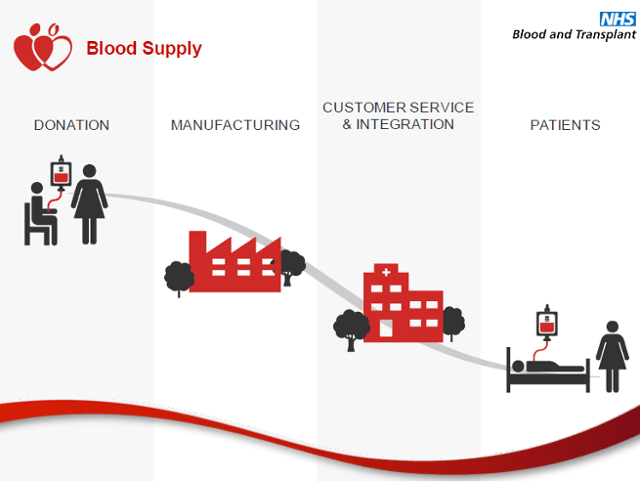 The backstory is that the NHS had a manually-intensive push approach for managing a rather complex supply chain: a team of 3000 people, 6000 units delivered every day, hundreds of hospitals, blood components of all kinds, and around the clock demand.
They transitioned to a demand-driven pull approach for a network that goes from blood donation to the end patient and all the steps in between. Their new system starts with electronic signals that communicate real-time demand from hospitals, which is then translated into a pull signal back through distribution, manufacturing, collection and supply. NHS calls it a comprehensive “vein-to vein” model.
Because the system is now highly automated, it has relieved hospitals of the time-consuming effort to order, manage and replenish blood supplies. The end result is an exceptionally patient-focused service that reduces costs, frees up hospital delivery costs and wastage, and insures a safe and stable blood supply for England.
I will admit that the video is a bit commercial, but please ignore the overtones and enjoy a unique and fascinating story.
The backstory is that the NHS had a manually-intensive push approach for managing a rather complex supply chain: a team of 3000 people, 6000 units delivered every day, hundreds of hospitals, blood components of all kinds, and around the clock demand.
They transitioned to a demand-driven pull approach for a network that goes from blood donation to the end patient and all the steps in between. Their new system starts with electronic signals that communicate real-time demand from hospitals, which is then translated into a pull signal back through distribution, manufacturing, collection and supply. NHS calls it a comprehensive “vein-to vein” model.
Because the system is now highly automated, it has relieved hospitals of the time-consuming effort to order, manage and replenish blood supplies. The end result is an exceptionally patient-focused service that reduces costs, frees up hospital delivery costs and wastage, and insures a safe and stable blood supply for England.
I will admit that the video is a bit commercial, but please ignore the overtones and enjoy a unique and fascinating story.
Click below to watch the NHS blood supply chain video:
The backstory is that the NHS had a manually-intensive push approach for managing a rather complex supply chain: a team of 3000 people, 6000 units delivered every day, hundreds of hospitals, blood components of all kinds, and around the clock demand.
They transitioned to a demand-driven pull approach for a network that goes from blood donation to the end patient and all the steps in between. Their new system starts with electronic signals that communicate real-time demand from hospitals, which is then translated into a pull signal back through distribution, manufacturing, collection and supply. NHS calls it a comprehensive “vein-to vein” model.
Because the system is now highly automated, it has relieved hospitals of the time-consuming effort to order, manage and replenish blood supplies. The end result is an exceptionally patient-focused service that reduces costs, frees up hospital delivery costs and wastage, and insures a safe and stable blood supply for England.
I will admit that the video is a bit commercial, but please ignore the overtones and enjoy a unique and fascinating story.
Click below to watch the NHS blood supply chain video: