
Gartner’s insights are quite good and it’s not often that I disagree, but on the topic of setting inventory targets I have to differ with the conclusions of a recent report, “Cover Considerations — How to Optimize Retail and Consumer Product Inventory Targets.”
There is a story about Abraham Lincoln arguing a case as a young lawyer. In his summation, he tells a story about a farm boy who runs to his father and says, “Pa, pa, the hired hand and sis are in the hay loft! She’s a liftin’ up her dress up and he’s a pullin’ down his pants and they are going to pee all over the hay.” The farmer puts his hand on the agitated boy’s shoulder and replies, “Son, you’ve got the facts right, but you’re drawing the wrong conclusion.”
In their report, Gartner has correctly identified the complexities of setting optimized inventory targets, but I would argue that they haven’t proposed the best way to solve it. That is, they have their facts right, but I’d say they have suggested the wrong conclusion.
Gartner’s report says that setting optimized inventory targets requires precisely incorporating interlocking variables like demand variability, service level targets, lead times, working capital and replenishment cycles. Then they outline six criteria for optimizing product flow through the supply chain to maximize order fulfillment and minimize inventory.
On the demand side, Gartner says inventory targets must consider demand forecast accuracy and demand volatility. They say that inaccurate forecasts require companies to hold excess stock to guard against shortages. They say that demand volatility (caused by natural fluctuations over time, sudden market shifts and extreme seasonality) necessitates extra inventory to account for these demand instabilities.
On the supply side, Gartner says those targets must consider both order supply and supply order reliability (orders arriving on time and in full), including:
 Interestingly, other recent Gartner reports have been promoting a more automated approach to supply chain planning. They say planners should focus on adding value, using their supply-chain domain expertise and knowledge of upside opportunities and risks, rather than focusing in time-consuming manual workarounds. For instance, Gartner’s Noha Tohamy says “decisions must be made faster and more dynamically, taking into account more factors than can be feasibly manually analyzed.” And Gartner analyst Andrew Downard says leading companies are “looking aggressively at places where they can use algorithmic planning and get people out of the process.”
I agree with Gartner’s analysis – setting inventory targets is a complex problem. But it’s a problem best solved by computer modeling and a highly automated approach to supply chain planning.
Interestingly, other recent Gartner reports have been promoting a more automated approach to supply chain planning. They say planners should focus on adding value, using their supply-chain domain expertise and knowledge of upside opportunities and risks, rather than focusing in time-consuming manual workarounds. For instance, Gartner’s Noha Tohamy says “decisions must be made faster and more dynamically, taking into account more factors than can be feasibly manually analyzed.” And Gartner analyst Andrew Downard says leading companies are “looking aggressively at places where they can use algorithmic planning and get people out of the process.”
I agree with Gartner’s analysis – setting inventory targets is a complex problem. But it’s a problem best solved by computer modeling and a highly automated approach to supply chain planning.

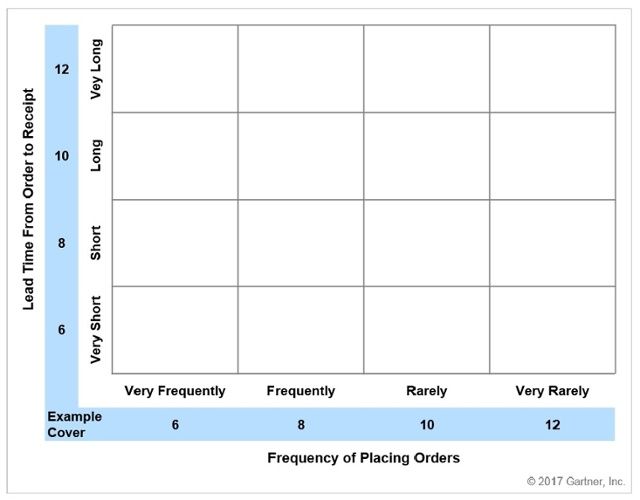
- Lead time from order to receipt – Linking inventory held in DCs or stores to lead times
- Frequency of placing orders – Connecting order frequency to inventory needs
- Order Receipt Lead Times – affect the amount of inventory that must be held in the meantime
- Order Receipt Completeness – governs inventory needed to mitigate risk of short shipments
Interestingly, other recent Gartner reports have been promoting a more automated approach to supply chain planning. They say planners should focus on adding value, using their supply-chain domain expertise and knowledge of upside opportunities and risks, rather than focusing in time-consuming manual workarounds. For instance, Gartner’s Noha Tohamy says “decisions must be made faster and more dynamically, taking into account more factors than can be feasibly manually analyzed.” And Gartner analyst Andrew Downard says leading companies are “looking aggressively at places where they can use algorithmic planning and get people out of the process.”
I agree with Gartner’s analysis – setting inventory targets is a complex problem. But it’s a problem best solved by computer modeling and a highly automated approach to supply chain planning.