September 2026
Taking the Friction Out of Planning
A smarter planning experience that helps users know what to focus on, why it matters, and how to act faster.
- See what matters sooner
- Act with more confidence
- Pick up where you left off
- Get guided through the cycle
A Message From Our CPO
Read transcript
Hi, everyone. I'm excited to welcome you to the inaugural edition of Decisive Pulse, our new quarterly product newsletter for tools group customers and partners. This is an important milestone for us. Yes, it's a chance to share some of the innovation happening across our products from user experience enhancements and major performance improvements to new innovations like DESI, our digital supply chain agent. But it's also one more way we're working to build a closer, more connected partnership with you. With you. You'll notice we kept the format simple. Our goal is to give you the updates that matter, keep the summaries brief and engaging, and provide links so you can dig deeper wherever something catches your interest. The name Decisive Pulse is intentional. Decisive complements the Dessian platform, our decision intelligence platform for supply chain planning, which we launched at the Engage event this past spring. And Pulse reflects our commitment to keeping you connected to the people, products, and progress here at Tools Group. This edition introduces the idea of always on decision intelligence powered by an agentic supply chain planning assistant we call DESE. It focuses on three major areas of recent investment, improvements to our user interface and overall experience, a completely reimagined Proposal Manager, and of course, the launch of DESE. Put simply, DESE helps you see what matters sooner, explain why, and recommend the action to take. Proposal Manager is redesigned to help you act with greater efficiency and confidence as you are managing your supply orders. Our UI improvements throughout our products help you move through the planning cycle faster with less friction and pick up right where you left off. These improvements will put you in the driver's seat, allowing you to focus on strategy while the frustrating manual planning tasks that waste time and steal your attention can be left to the system. So two sections I especially love, our customer spotlight, where we celebrate what our customers accomplish, and our team spotlight, helping you get to know the people behind the products. And finally, before you go, be sure to click the link to sign up for our virtual decisive webinar scheduled for October fifteen. It's another great way to connect with us, and we hope to see you there. I hope you enjoy this first edition of decisive faults.
Meet Decy
Read transcript
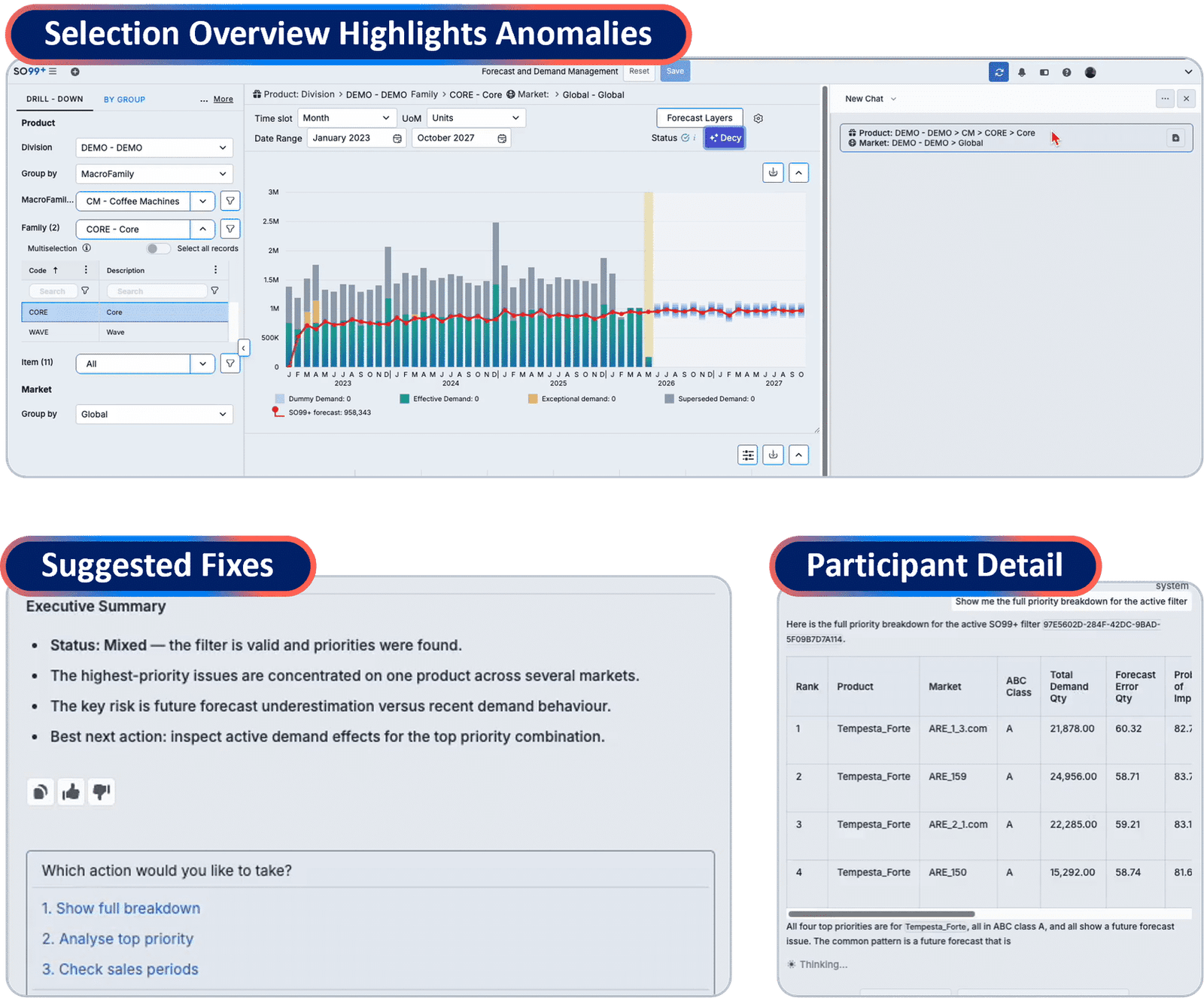
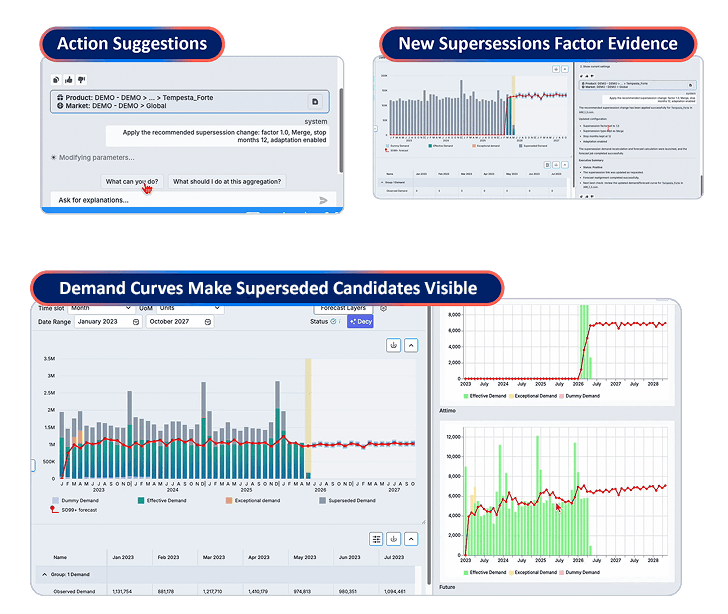
Planning is changing with Decy. An agentic assistant always by your side supporting you in daily tasks transforms the way you work. We believe much for the better. Take an everyday example. You're the demand planning manager, and you start your day as you always do: Checking Insights to see if critical KPIs are on track, when you notice that high margin items are at risk of stock out, you immediately dive into the forecast to see why. After all, you've not seen a problem in the category overall. Sure enough, the forecast at first glance seems fine at the global level, matching what you'd been monitoring in insights. When looking at the forecast at the product macro family level for coffee machines, where margin is the key concern, still no problem emerges. The Core line family had the most new product introductions recently, so you go a level deeper to see if perhaps the problem will be obvious there, but it still looks fine. Now what can you do? Working the old way, you'd have to check each item one by one to find, much less fix, the problem. Luckily, Decy makes it easy. You simply open a conversation and already Decy knows that you're looking at coffee machines in the Core line and suggests looking for problems at that level. Decy immediately begins its analysis, not just pulling the data but also prioritizing the most critical issues. It writes up the key details while also pulling the most important insights into an executive summary. When you read it, the problem product that triggered this work is obvious. All four of the critical tasks highlighted by Decy center around the same product, Tempesta Forte. You can't imagine why a single product could be creating so much trouble, so you ask for more details from Decy. Based on the breakdown of the product, you realize it is a new product introduction as you suspected, which Decy confirms, so you ask it to dig into the supersession configuration. This forecast for this new machine has been seriously underestimating demand since it was introduced in March, capturing only about fifty percent of the actual demand even though the baseline item Tempesta seems like it should be a good fit. So now you need to fix it, and luckily, Decy has recommended what to do to solve it as well. It turns out that the item you use to generate the initial demand profile through supersession has not been a great fit for the actual demand. Decy suggested that you make the supersession factor adaptable moving forward, and in the meantime, you correct the supersession factor to one point zero. You tell Decy to go ahead and do both, allowing Decy to do the difficult analysis to find the statistically optimal supersession factor on your behalf. As soon as Decy finishes the work, he lets you know. You refresh the forecast and see that it looks much better. You can also check exactly what actions Decy took by looking in the jobs queue. So you're starting to feel much better. You fixed a major problem in a fraction of the time. But before you assume that Tempesta Forte is the only new product with an issue, you want to check that no other product lines have similar issues hidden by a global forecast accuracy and service level that is on target. So you take a look at the other product line, Wave, which also looks good on the surface, but you ask Decy to do an analysis at this new aggregation just in case. Decy runs an analysis and finds another item where the forecast isn't performing well, Rock Plus. Rock Plus, like Tempesta Forte, is a recently added product with a systematic underforecast covering just forty five percent of the actual demand. DESE tells you that the demand relationship with predecessor item future is weak and recommends finding a new source. You ask Decy to go ahead and do so, keeping it in the Wave family. Decy tells you that Attimo is the strongest match within the Wave family, but before you go ahead with changing the predecessor item, you want more detail. A visual would be nice to understand better how the demand profiles actually compare. Decy can help there too. He generates the forecasts the way you'd typically be used to seeing them in the demand planning module with the bars showing actual past demand and the forecast laid over it in red. He also generates an executive summary highlighting what you should be noticing within each chart. When you hone in on the Rock Plus forecast in the main pane, you can see that it matches the chart generated by Decy. But Decy isn't limited to charts that match system presets. He can generate new charts that enhance your understanding and support better decisions on the fly. You ask him to show Attimo and Rock Plus on a single chart to better compare the two, specifically asking it to highlight why Attimo is a good choice so you can feel confident in the recommendation. Once Decy is done, you can see that demand is converging even more in recent months, so you can feel confident that Attimo is the right choice. You tell Decy to make the swap and Decy executes. When you refresh, you can see that the demand trend matches actual demand much better. You've checked both coffee machine lines for problems and resolved them in the time it would take your boss to get a coffee and start her day. When she starts, she'll arrive to a message alerting her of the negative trend, explaining what went wrong and how you have already solved it. Decy makes this kind of thing possible every day, helping you move much faster, supporting your analysis, and executing on your strategy. The major choices still require your expertise, but you have a really knowledgeable ToolsGroup assistant at your side all the time, making the process go much more smoothly.
-
Aggregate Selection Analysis for Every Participant in the Selection Improves Exception Prioritization
-
Why:
Looking at the big picture can sometimes hide participant-level issues. Decy now brings those exceptions to the surface, so you can spot them right away.
-
The benefit:
Find and fix exceptions faster with fewer manual checks.
Detect hidden issues
Explores possible problems for each individual participant
Prioritize what to fix
Ranks alerts and actions by impact at aggregation level
Guide the drill‑down
Points users to causes such as exceptional demand peaks
-
Supersession Recommendations and Factor Adjustments Improve Performance for Product Transitions.
-
Why:
When product launches or transitions don't perform as expected, it can be hard to know the best next step.
-
The benefit:
Decy highlights recommended actions and historical options to support smoother transitions and replenishment planning.
Review current links
Start from existing supersessions and their active factors
Compare demand history
Use multiple candidates to identify the most reliable source
Apply recommended action
Adjust factors or initialize a new item with confidence
New Item Plan Matrix in Assortment Planning
-
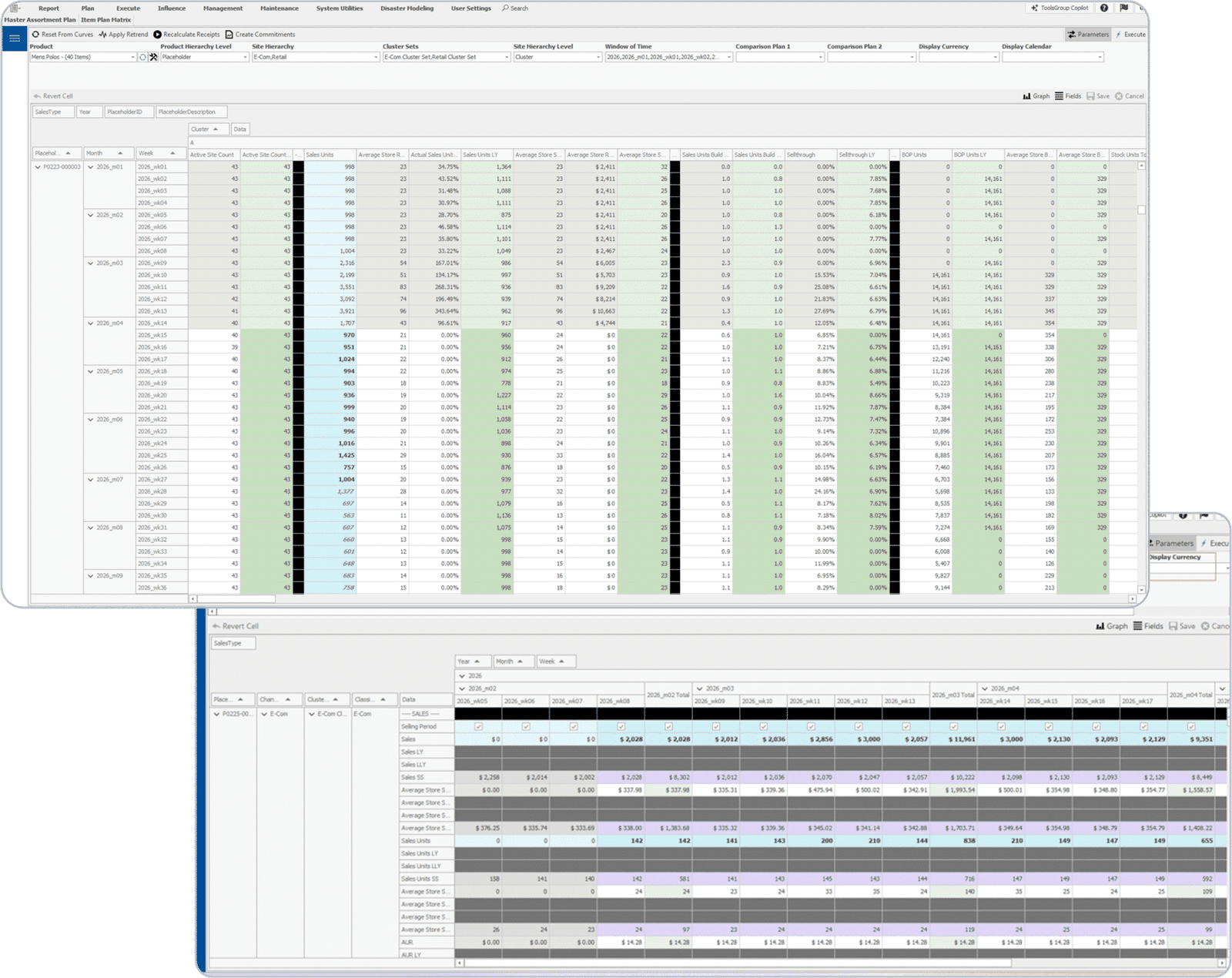
Editable Item Plan Matrix (IPM) Embedded in Core Planning Workflows
-
Why:
Planners need a faster path from planning to execution without bouncing between views or losing context.
-
The benefit:
IPM allows you to plan and take action in one place, saving time and keeping you focused.
New in‑matrix actions
New in‑matrix actions (Apply Curves, Re-trend, Calculate Receipts, Create Commitments) streamline execution steps.
Alignment and visibility
Behavior alignment and hierarchy‑aware visibility improve predictability and reduce accidental over‑commitment in aggregated views.
Saved Layouts
Saved Layouts allow users to quickly access the metrics needed for the task at hand, reducing setup time across planning workflows.
-
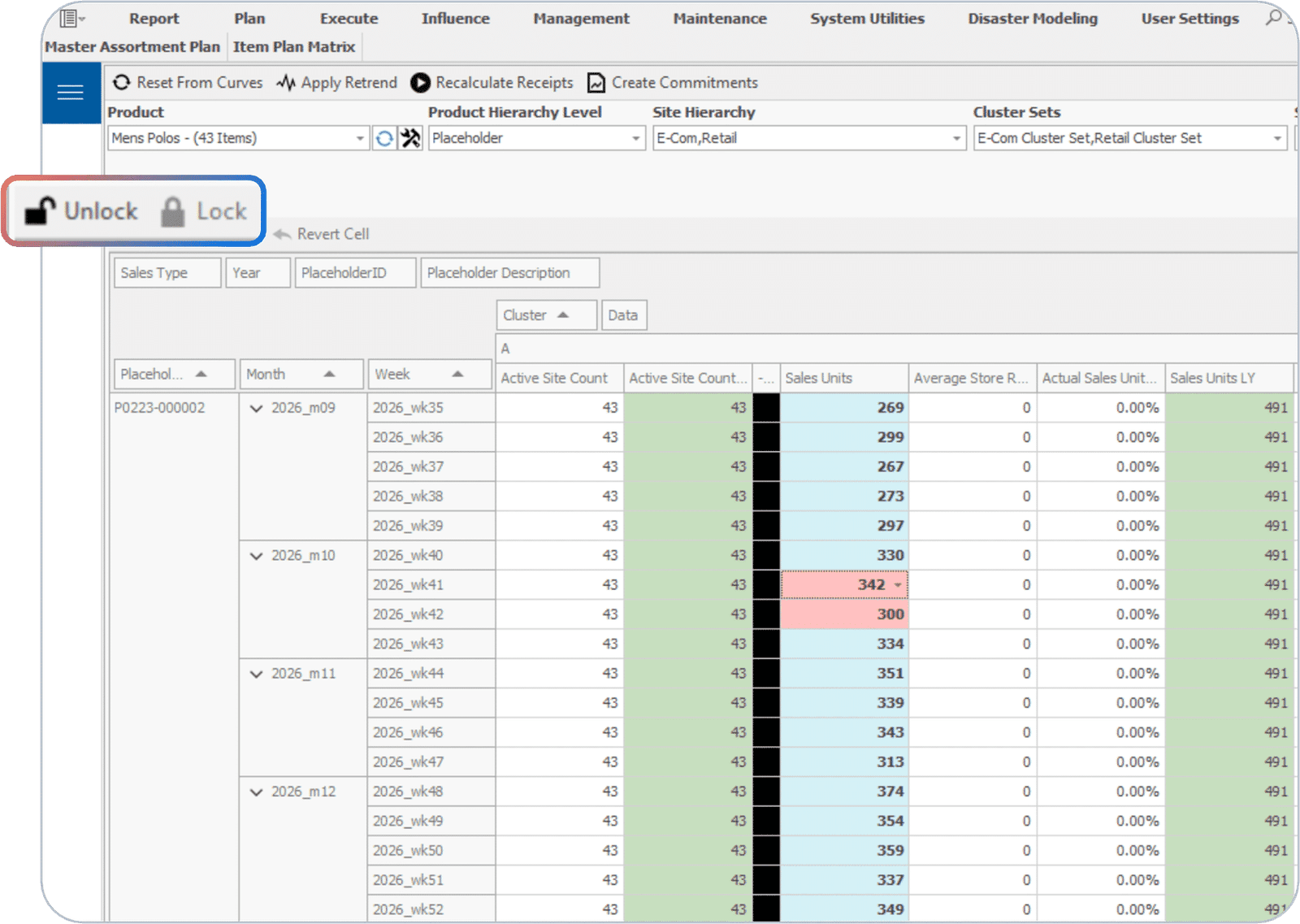
Greater Planning Control with Item Plan Matrix Locking
-
Why:
Assortment planners need to be able to refine their plans without worrying about finalized values being changed.
-
The benefit:
Lock important metrics to keep them protected while you continue planning with confidence.
Planner control
Planners can lock key metrics such as Sales Units, Sales, AUT, Receipt Units, Receipt AUC, and related planning values.
Locks
Locking a parent automatically secures child records, while lower-level locks appear as partial locks at aggregate levels.
Sales and Receipt
Independent Sales and Receipt metric control lets planners protect one planning area while continuing to refine another
Locks feedback
Dark pink and light pink feedback helps users quickly identify full versus partial locks
Enhanced Scenario Approval in Rebalancing
-
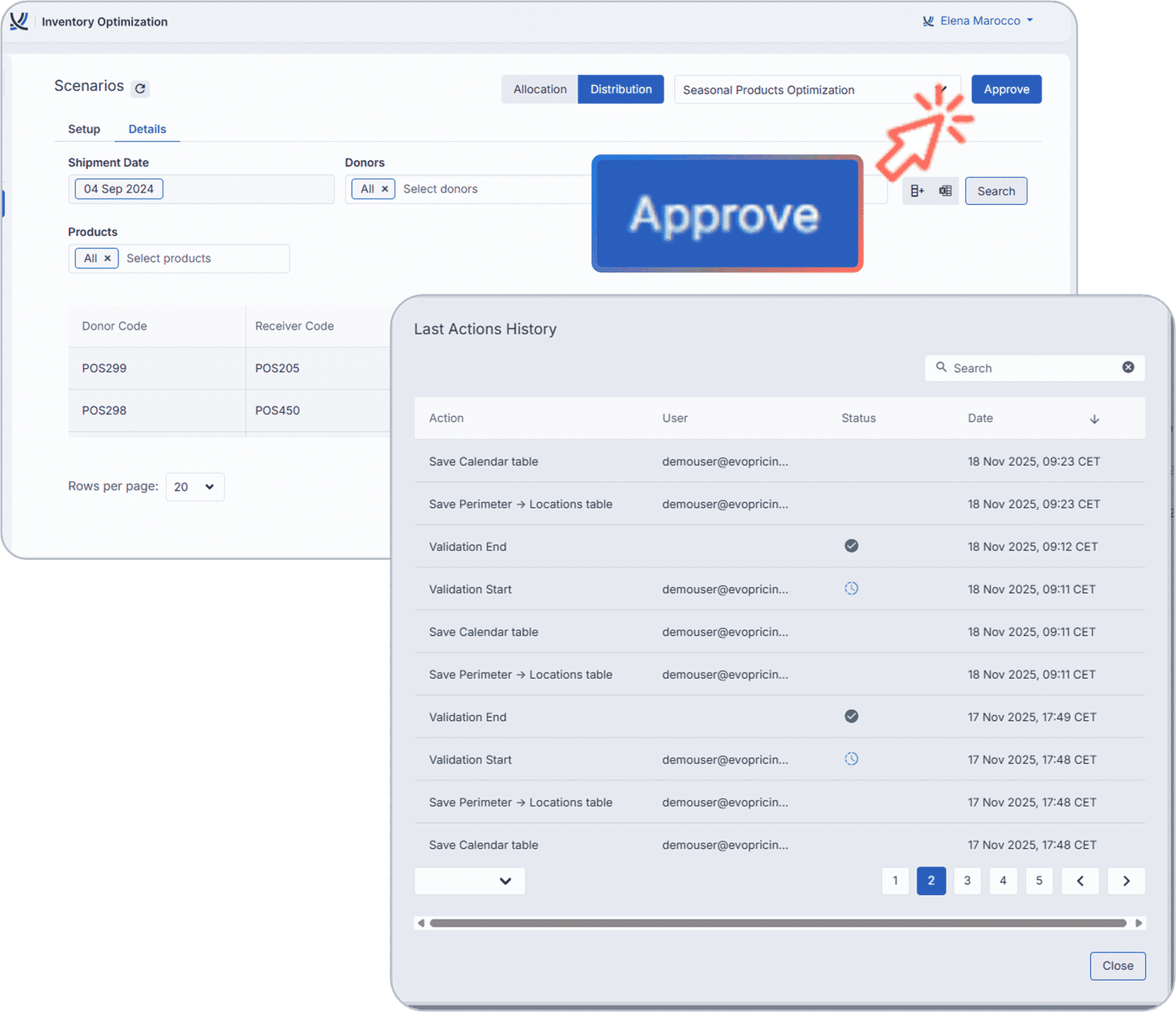
Governed Scenario Approval Improves Rebalancing Plan Confidence
-
Why:
Scenario results need validation before they're put into action.
-
The benefit:
Approve and track scenario decisions with confidence before sharing them downstream.
Approve scenarios
Approve scenarios through a structured workflow before results are released downstream
Support customer-specific output customizations
Support customer-specific output customizations so results can be delivered and consumed in the required format.
Improve visibility and traceability
Improve visibility and traceability across the set-up and approval processes
-
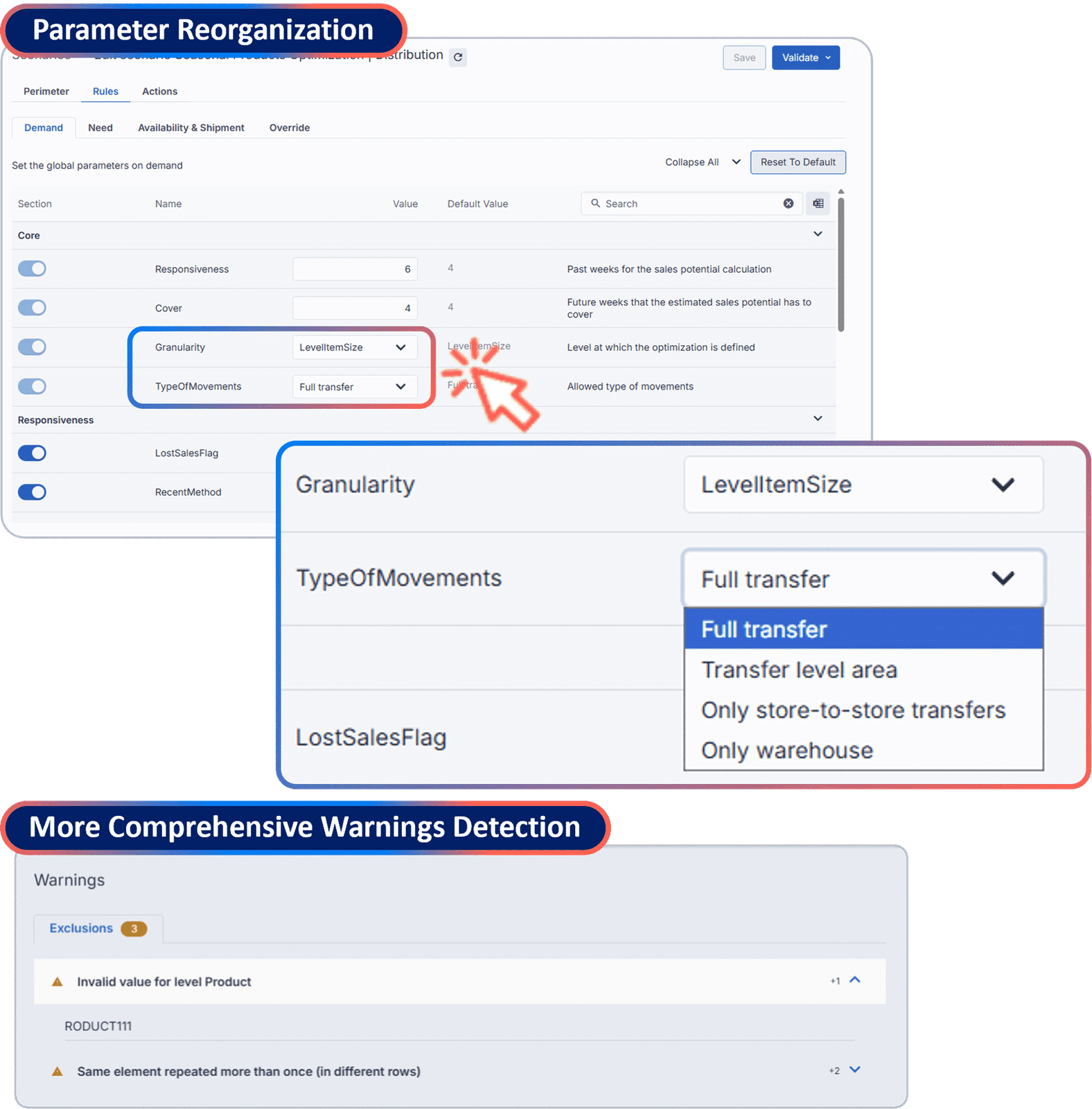
Simplified Rebalancing Scenario Configuration Reduces Setup Complexity
-
Why:
Scenario configuration wasn't always easy to navigate.
-
The benefit:
A simpler setup experience with parameters organized for a smoother process.
Separate configuration from scheduling
Separate configuration from scheduling by organizing parameters in dedicated Rules tabs.
Help planners
Help planners identify data-quality issues earlier with expanded input checks.
Improve reliability
Improve reliability through detection of duplicated or conflicting rules, clearer warnings, and better error messages.
Behind the Impact
Customer Success Starts with Our People
Read transcript
So my name is Zara Lamont. I'm a senior solutions consultant in the Tools Group Professional Services based out of Australia. I'm actually originally from South Africa and I joined Just Enough as a graduate in twenty seventeen. It started as mostly an opportunity to travel, to be honest. Quickly turned into a love for consulting. I discovered that I really enjoy helping customers. I love the technical work. I love solving complex business challenges. And also just seeing that impact that makes the processes better and using technology to improve the day to day of our customers. Today, I work closely with our customers in the APAC region, but also in Europe and in South Africa. So I work with them to design and implement the solutions to improve their planning and replenishment. And I also go on-site. I spend some time with the customers training them. So, I am involved from the beginning to the end of the projects, which is really nice. I get to see the entire life cycle as things come to fruition. What I enjoy the most is honestly the opportunity to learn from every customer that I work with. Every organisation is so different and it's fascinating to really understand how they operate, the challenges that they face, and what makes them successful. So I have the opportunity to look into so many different industries, so many different companies, spend some time on-site with them. And I think what I enjoy the most is those collaborative challenging design sessions, where we debate challenge ideas and explore different approaches and work together to find that optimal solution. Those conversations often lead to the most innovative outcomes. I think just as importantly, I actually enjoy building relationships over years with our customers. Technology projects are ultimately about the people behind the screen. So getting to know the individuals behind the screen is one of the most rewarding parts of the job as well. One of the projects that I'm particularly proud of is implementation for an Australian owned homeware and kitchenware retailer. The project presented a lot of challenges. We navigated significant staffing changes from the customer side. We supported the business through major acquisition. And then we also tried to maintain momentum through a very busy December season. But despite all of those challenges, the partnership remains strong, the relationship remains strong, and we're now in the final stages of the implementation. It's going live in May this year. The customers actually reported some fantastic results. So we've seen an availability increase from eighty two percent to over ninety five percent. Their inventory holding has been reduced by ten percent. They also mentioned that they've seen certain departments that were historically struggling, having an increased sales of twenty percent. So, it's really good. But while those numbers are incredibly rewarding, I think my favorite moment came from the feedback shared by customer. During a recent meeting with their branch managers, the branch managers literally started applauding because they were finally seeing the right stock in the right stores and their days have just become so much less stressful. So for me, that is what success looks like. It's not just about implementing the software, it's about creating those outcomes that make a real difference to the real people doing the jobs in the background. My approach is really to focus on practical business value from day one. So traditionally, we used to implement projects often relying on heavy design sessions and workshops. Today, we take a more iterative approach. So I like to focus on getting the fundamentals right first, getting the users into the system as early as possible, and creating opportunities for hands on learning and feedback loops. So that allows the customer to make decisions based on real experience rather than assumptions in the beginning. They don't know what they don't know, right? So I think this creates stronger adoption because the users become part of that solution building process and they see things evolve and what works and what doesn't work. I spend a lot of time working alongside the users, understanding their processes end to end, and then ensuring that we're not just implementing technology, but we're helping to improve the way that they work as well. I think that approach has seen much better results and has proven to be a lot less overwhelming for the users in the end. Most rewarding moments, I think, is when you see the customer's face light up, when they realize something that used to be really difficult has all of a sudden become simple. Whether it's a planner saving hours of manual work, a store receiving the right stuff at the right time, or just a user gaining that confidence in the system and being able to check around really quickly, Those moments remind you why the work does matter. And also seeing the customers become successful and knowing that you've paid personal advice in helping them reach those goals in their day to day. My biggest piece of advice is to listen first. So take the time to understand the real problem before focusing and jumping right to the solution. A symptom a customer describes isn't always the underlying challenge. You need to dig a little bit deeper. I would also encourage people to think beyond system functionality and focus on improving the underlying processes. Great outcomes happen when technology supports good processes. So you can't always fix a bad process with implementing a solution. And then finally, I think put yourself in the user's shoes. Use the system the way they use it. Complete the tasks that you're asking them to complete in the system. I think this builds empathy. It also uncovers improvement opportunities and helps you deliver a solution that generally works in real life and not just theoretically.
See What’s Taking Shape for Retail
Join us at the Retail Workshop on October 21 for a demonstration of the latest progress and a preview of what’s ahead.