Probabilistic Demand Forecasting Software
Model demand uncertainty with AI-driven probabilistic forecasting that improves inventory, service levels, and supply chain responsiveness.
ToolsGroup probabilistic demand forecasting software helps organizations move beyond static point forecasts by modeling the full range of possible demand outcomes. Using AI and machine learning, the platform improves forecast accuracy, reduces inventory risk, increases service levels, and enables more resilient supply chain planning decisions.
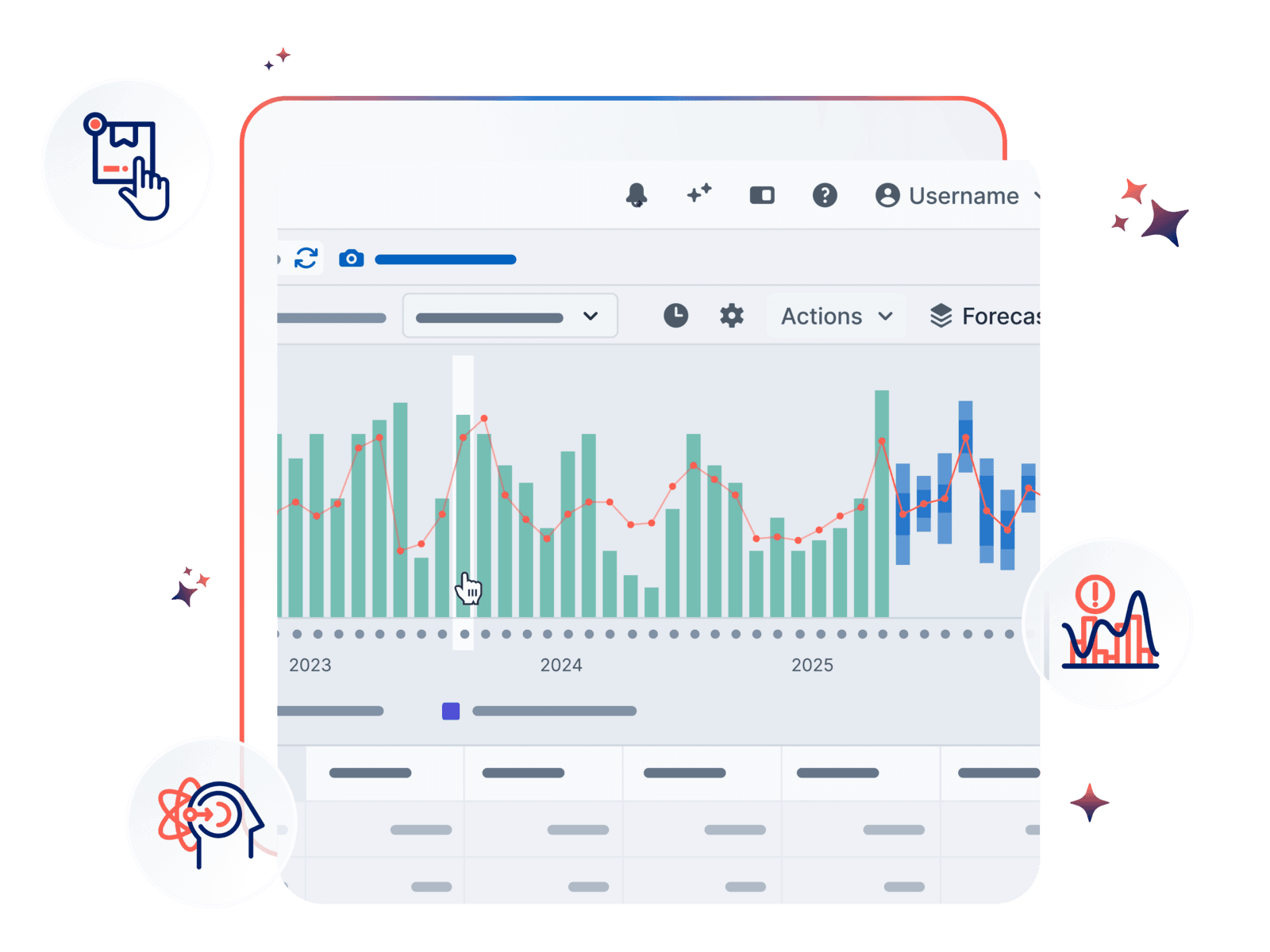
Improve Forecast Accuracy While Reducing Inventory Risk
Probabilistic forecasting helps organizations optimize inventory, improve service levels, reduce forecast error, and respond faster to volatility.
-
5-15 pt
Forecast accuracy improvement with probabilistic AI
-
20-30 %
Inventory reduction through better demand visibility
-
40-50 %
Better forecastability of slow sellers and SKUs with intermittent demand
-
30-50 %
Reduction in stockouts
Overview
AI Forecasting That Models Real Supply Chain Uncertainty
ToolsGroup probabilistic demand forecasting software helps organizations improve forecasting accuracy by modeling uncertainty directly instead of relying on single-point demand assumptions. Using probabilistic AI and machine learning, the platform continuously analyzes historical demand patterns, seasonality, promotions, external signals, and operational changes to generate confidence intervals and demand probability distributions. This allows organizations to make better inventory, replenishment, and service-level decisions under changing market conditions. Designed for manufacturers, aftermarket organizations, wholesale distributors, and retailers, the platform improves responsiveness to volatility while reducing excess inventory, minimizing stockouts, and increasing forecast reliability across complex global supply chains.
Key Benefits
Improve Inventory Decisions
Respond to Volatility
Reduce Stockouts
How ToolsGroup Is Different
-
Self-adaptive AI forecasting
AI-powered, self-adaptive forecasting detects hidden demand patterns and continuously fine-tunes models to improve accuracy while reducing bullwhip effects.
-
Full probability distributions
Full probability distributions for every SKU-location improve understanding of demand uncertainty, planning risk, and customer behaviour.
-
Built for hard-to-predict demand
Superior forecast performance across long-tail, intermittent, highly seasonal, and promotion-driven demand that traditional forecasting struggles to predict.
Traditional Forecasting Ignores Demand Uncertainty
- Point forecasts rely on single-number assumptions that fail to capture demand variability and operational risk effectively.
- Forecasting models struggle to adapt quickly enough to promotions, seasonality, external events, and changing customer behavior.
- Forecast error creates excess inventory, stockouts, poor service levels, and inefficient supply chain decision-making.
- Traditional planning methods cannot scale effectively across large SKU counts, locations, and volatile supply chain networks.
Probabilistic AI Forecasting
- Probabilistic forecasting models the full range of demand outcomes instead of relying on static point estimates.
- AI continuously analyzes demand patterns, uncertainty, seasonality, and market signals in real time.
- Forecast confidence intervals improve inventory, replenishment, and service-level decision-making across supply chains.
- Adaptive forecasting improves responsiveness while reducing inventory risk and operational inefficiencies.
Connected Forecasting Capabilities Across Supply Chain Planning
Integrated forecasting solutions that improve responsiveness, accuracy, and inventory performance across global operations.
Trusted by Leading Global Supply Chain Organizations


-
We needed a planning process to improve sales forecasts, increase service levels and optimize inventory.

-
Such a diverse and extensive range of products can lead to excessive inventory levels, making the sourcing adjustments very complex and extending this complexity to the production centers.
 Impact 18pp increase overall service levels
 -
We’re able to look at different scenarios, service classes and lead times to figure out if we need to raise or lower the service level. The demand planning helps me confidently forecast even items with unpredictable demand.

Why Enterprises Choose Probabilistic AI Forecasting
ToolsGroup helps organizations move beyond static forecasting with AI-driven probabilistic models that improve responsiveness and inventory decisions.
Feature
ToolsGroup
Traditional Planning
Forecasting
ToolsGroup Probabilistic models capture uncertainty dynamically
Traditional Planning Static point forecasts ignore demand variability
Responsiveness
ToolsGroup AI adapts continuously to changing demand signals
Traditional Planning Forecast updates occur too slowly
Inventory Decisions
ToolsGroup Confidence intervals improve inventory optimization
Traditional Planning Inventory decisions rely on inaccurate assumptions
Scalability
ToolsGroup AI forecasting scales across large complex networks
Traditional Planning Manual forecasting struggles at enterprise scale
Built for Complex Forecasting and Inventory Operations
ToolsGroup probabilistic forecasting software supports retailers, manufacturers, distributors, and supply chain teams managing uncertainty, volatility, and complex inventory decisions.
Demand Planning Teams
Improve forecasting accuracy by modeling uncertainty directly instead of relying on static point forecasts and manual forecasting adjustments.
Supply and Production Teams
Probabilistic modeling accounts for lumpy demand, smoothing inventory plans, so it's easy to keep production lines moving and optimize inventory positioning without chaos.
Supply Chain Leaders
Reduce inventory risk, improve service levels, and increase operational responsiveness across global multi-echelon supply chain networks.
Retail & Operations Teams
Respond faster to promotions, seasonality, and changing customer demand using adaptive probabilistic forecasting and real-time planning intelligence.
Probabilistic Forecasting Insights
Guides, research and customer results from teams solving the same problem.
-

Managing Long-Tail Demand in Industrial Manufacturing
Long-tail demand is the persistent, low-volume requirement for a wide range of items that individually sell infrequently but collectively represent meaningful service expectations, revenue, and operational complexity.
Read more -

Probabilistic Planning: The Supply Chain Advantage
Probabilistic planning drives real supply chain innovation—beyond buzzwords like AI and automation—with ToolsGroup’s SO99+ platform.
Read more -

ToolsGroup Partners with Natuzzi to Transform Global Supply Chain Planning
Digital Transformation Initiative Empowers Iconic Italian Furniture Brand to Anticipate Demand, Optimize Inventory, and Boost Service Levels
Read more
Frequently Asked Questions
Everything you need to know about probabilistic demand forecasting with ToolsGroup
What is probabilistic demand forecasting?
Probabilistic demand forecasting predicts a range of possible demand outcomes instead of relying on a single-point forecast. By modeling uncertainty directly, organizations can make better inventory, replenishment, and service-level decisions across complex supply chain operations.
How is probabilistic forecasting different from traditional forecasting?
Probabilistic demand forecasting calculates the full a range of possible demand outcomes and the likelihood of each occurring instead of relying on a single-point forecast. By modeling uncertainty directly, organizations can make better inventory, replenishment, and service-level decisions across complex supply chain operations.
Why are point forecasts unreliable?
Traditional forecasting typically generates a single forecast, while probabilistic forecasting models multiple possible outcomes and their likelihoods. With traditional forecasting, the only thing you can know with certainty is that your forecast will be wrong. Probabilistic forecasts hedge against risks and unknowns, providing greater visibility into true demand, volatility, and supply chain risk.
How does probabilistic forecasting improve inventory decisions?
Probabilistic forecasting helps organizations optimize inventory decisions by providing confidence intervals and demand probability ranges. This improves safety stock positioning, replenishment planning, and service-level performance while reducing inventory risk.
What is forecast uncertainty in supply chains?
Forecast uncertainty refers to the variability and unpredictability of customer demand over time. Factors such as seasonality, promotions, supply disruptions, economic conditions, and changing buying behavior all contribute to forecasting uncertainty.
How does AI improve forecasting accuracy?
AI improves forecasting accuracy by continuously analyzing large volumes of historical, operational, and real-time demand data. Machine learning models can detect patterns, volatility, and demand shifts faster and more accurately than traditional forecasting methods.
How does probabilistic forecasting improve service levels?
By modeling uncertainty directly, probabilistic forecasting helps organizations maintain optimal inventory levels and reduce stockouts. This improves product availability and enables higher service levels across supply chain operations.
What industries benefit from probabilistic forecasting software?
Probabilistic forecasting software is widely used across retail, manufacturing, food and beverage, wholesale distribution, consumer goods, and aftermarket industries where organizations manage volatile demand and complex inventory networks.
Ready for Probabilistic Forecasting that Delivers?
Find out why analysts and customers alike consistently rank ToolsGroup's probabilistic AI forecasting among the most resilient demand planning solutions in the industry.